Coloring Page ASMR Drawing
- 3.6
- Rating
- 10.00M
- Installs
- Free
- Price

 Analysis by App-foxy
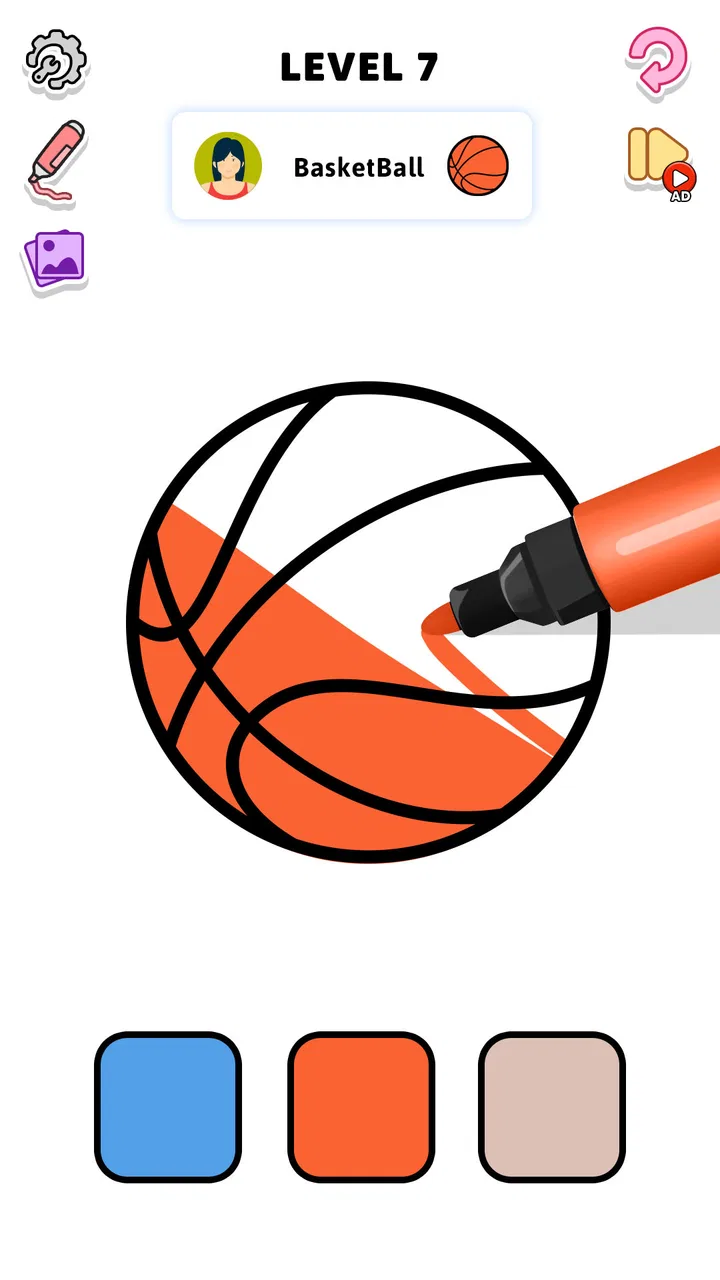
Coloring Page ASMR Drawing is the kind of casual simulation game I open when I want a quiet activity rather than a demanding challenge. Its central idea is simple: I drag my finger across an outlined picture and gradually fill it with color. That sounds modest, but the appeal comes from the combination of slow hand movement, visible progress, and a soft art-focused mood. It feels closer to a short digital coloring break than to a traditional game built around competition or complicated goals.
After spending time with it, I see the strongest reason to try it as a low-pressure way to occupy your hands and settle your attention. It suits short sessions while waiting, winding down before bed, or taking a break from faster games. At the same time, anyone expecting deep drawing tools, a large creative sandbox, or a story-driven simulation will probably find the experience too limited. The game knows what it wants to be, and its success depends on whether that narrow purpose matches your habits.
How the first few coloring sessions feel
The first impression is immediately understandable. There is no need to learn a complicated control scheme: I use my finger to trace and color the picture, watching the blank design become more complete. That direct interaction is important because it removes the usual barrier between opening a game and actually playing it. I do not need to study menus or remember a long sequence of commands before the activity starts.
You May Also Like

 Blood Strike: 2.5 Anniversary
Blood Strike’s Loadouts Turn Every Drop Into a Tactical Gamble
A close look at Blood Strike’s custom loadouts: how fast access to signature weapons reshapes its battle royale rhythm, rewards preparation, and narrows the gap between fights.

 Pandora - Music & Podcasts
Pandora’s Music Is Easy to Start, but Harder to Recover
Pandora’s strength is its low-effort path from a seed to a station. Its weak spot is how much confidence it asks you to place in connection, setup, and quiet recovery.

 8 Ball Pool
 Is Built on Rivalries, Rematches, and Routine
A close look at the rivalries, rematches, shared routines, and unanswered safety questions that turn a quick pool match into a persistent mobile community.

 Samsung Music
’s Quiet Strength Is Playing What You Already Own
Its reach comes less from spectacle than from dependable access to a personal library. That simplicity is both the app’s strongest retention engine and its ceiling.

 AccuWeather: Weather Radar
AccuWeather Review: A Quick, Clear Forecast for Everyday Decisions
For everyday plans, the best forecast is the one you can understand quickly. AccuWeather makes rain timing, radar, and local conditions easy to act on, with a few trade-offs.

 Hill Climb Racing
Why Hill Climb Racing Still Turns Crashes Into One More Run
A tiny car, a bumpy hill and one more upgrade: Hill Climb Racing keeps resurfacing because its simple chaos makes every near-miss feel personal.
More From Our News Desk



The presentation also makes the game approachable for a wide audience. It is listed as suitable for Everyone, which matches the gentle nature of the activity. The developer, stick hunter, has focused the experience on a familiar coloring action rather than on combat, pressure, or difficult objectives. That makes it easy to recommend to someone who rarely plays mobile games but enjoys simple visual tasks.
I would not describe the opening as dramatically exciting. There is no strong narrative hook pulling me forward, and the attraction is not based on surprise. Instead, the game relies on the small satisfaction of completing sections of an image. If you like seeing a messy or unfinished page become orderly through repeated movement, the first session communicates that pleasure quickly.
The free entry point helps with trying the concept. The game is free to download, while optional purchases are priced at $2.99 per item. That means I can test whether the coloring loop suits me before spending anything. Still, I would approach purchases carefully. A relaxing game can lose some of its value if I start treating every desirable addition as something I need to buy, so I prefer to enjoy the basic routine first and decide later whether extra content genuinely improves it.
A good fit for short, repeatable breaks
My favorite use case is a ten-minute pause during an ordinary day. If I have finished a task but do not want to begin a full game, I can open a page, make steady strokes, and stop after a small amount of progress. The activity does not demand the same commitment as a level-based action game. I can leave after a brief session without feeling that I abandoned an important objective.
That convenience also makes it useful for people who prefer predictable entertainment. There is no need to build a strategy or react quickly. The reward comes from attention and completion, not from mastering a difficult system. I can play while sitting on public transport, during a quiet break, or at home when I want something more engaging than simply scrolling.
However, this is not the right choice for every kind of boredom. When I want a strong sense of discovery, a competitive target, or a story with characters and consequences, coloring cannot provide that depth. It is also not an ideal replacement for a serious digital art application. The game gives me a guided coloring activity, not an open canvas where I control every artistic decision.
How the artwork creates its own visual language
The art direction is built around outlines, color areas, and the gradual transformation of a page. That visual language is coherent because every element supports the same action. The picture begins as a task to complete, and each successful stroke makes the result more readable. I never feel that the interface is asking me to perform an unrelated action just to move forward.
What I notice most is the difference between coloring for expression and coloring for completion. In a conventional art app, I might choose a brush, mix shades, adjust opacity, and decide exactly where a mark belongs. Here, the page guides my hand. That reduces creative freedom, but it also reduces uncertainty. I do not have to wonder whether I am using the correct tool or whether a blank area is intentional. The structure tells me what to do next.
This guided approach is especially helpful when I want the visual reward without the pressure of making something from nothing. I can concentrate on choosing where to move and watching the image develop. For a child or a casual player, that can feel more welcoming than an empty canvas. For an experienced illustrator, it may feel restrictive because the game’s strength is its boundaries rather than its flexibility.
One practical tip is to treat the outline as a pacing tool instead of rushing to finish the page. I get more from the experience when I work through smaller areas carefully, allowing the image to change in stages. Trying to sweep across everything as quickly as possible turns the activity into a repetitive gesture and makes the visual progression less satisfying.
Why the setting matters even without a story
There is no need for a traditional fictional world to create a sense of place here. The “setting” is the page itself: a quiet workspace where the image, the finger movement, and the emerging colors share attention. That is a smaller kind of world-building, but it works because the game does not distract me with systems that do not belong to the coloring mood.
This focus also explains why the game can feel calming without being completely passive. I still make decisions about movement and pace, and I can see the consequences immediately. The page acts like a contained environment with a beginning, a middle, and a finished visual result. That structure gives a short session enough shape to feel purposeful.
The trade-off is that the atmosphere may become familiar quickly. Since the basic language stays centered on coloring pages, players who need frequent changes in scenery may lose interest. I would recommend it more confidently to someone who enjoys a consistent ritual than to someone looking for constant novelty.
Sound, rhythm, and the ASMR promise
The ASMR angle is most convincing when I play slowly and let the interaction set the rhythm. The repeated motion of dragging across the page creates a gentle routine: move, fill, observe, continue. That rhythm is more important than speed. The experience works best when I am not trying to optimize every stroke but allowing the process to unfold at a comfortable pace.
I would describe the sound design as part of the mood rather than the main event. The game’s identity depends on the feeling of a tactile coloring session, so any audio feedback is most useful when it supports the hand movement instead of competing with it. This is a subtle distinction: the game is not a music game, and it does not turn coloring into a performance. Its sound-related appeal comes from reinforcing the sense that each action has a small, satisfying response.
For the best result, I play in a relatively quiet environment and keep my own pace steady. In a noisy room, the calming effect is naturally weaker because the surrounding sound dominates the experience. I also find that very long sessions can flatten the rhythm. The repeated action is pleasant in moderation, but it does not automatically become more rewarding simply because I continue for a longer time.
That pacing creates one of the game’s clearest strengths and weaknesses. A slow loop can help me decompress after an intense day, yet the same loop can feel monotonous when I am already restless. If I need stimulation, a puzzle game with escalating difficulty or a creative app with more control would serve me better. Coloring Page ASMR Drawing is at its best when I want repetition to be soothing rather than challenging.
Using the rhythm as a practical focus exercise
One non-obvious way I use the game is as a transition between activities. Instead of opening social media immediately after work or study, I spend a short period completing a small portion of a page. The limited action gives my attention somewhere harmless to go while marking a clear break from the previous task. It is not a formal concentration tool, but the predictable hand movement can make the transition feel less abrupt.
I also avoid judging the result too early. If I look at the image only as a finished product, the middle of the session may seem unimportant. When I pay attention to the sequence of partial changes, the pacing becomes the reward. This is a useful mindset for anyone who finds ordinary coloring games dull after the initial novelty.
Where the mechanics succeed and where they stop
The core control is well matched to a touchscreen. Dragging a finger is natural, immediate, and easy to repeat. The mechanic does not ask for precision in the same way as a fast platformer or a competitive shooter, so it remains accessible on a phone. The simplicity is not an accident; it is what allows the game to function as a relaxing simulation rather than a test of reflexes.
At the same time, simple controls do not automatically create deep gameplay. The main challenge is maintaining interest through the sequence of pages and the satisfaction of completion. If I want new rules, stronger obstacles, or meaningful strategic choices, I will not find much of that here. The game’s progression is primarily experiential: I continue because I enjoy coloring another image, not because the mechanics keep unfolding into a complex system.
This is where comparison with the usual alternatives becomes useful. Traditional coloring apps generally appeal to people who want more control over palettes, brushes, and personal composition. They are better when I want to create an image according to my own plan. Coloring Page ASMR Drawing is more approachable when I want the page to guide me and remove technical decisions.
On the other side, puzzle and simulation games often give clearer goals, resource management, or escalating difficulty. They are stronger choices when I want a sense of mastery. This game is better when I want a repeatable visual ritual. Neither approach is automatically superior; they serve different moods. The important question is whether I am looking for artistic freedom, challenge, or a calm guided activity.
Small workflow choices that improve the experience
I get better results by treating each page as a short session instead of trying to force a marathon. Completing a section, pausing, and returning later keeps the action from becoming mechanical. It also makes the visual progress easier to notice. For younger players, this approach can turn the page into a manageable task rather than something that feels endless.
Another useful habit is to play with a clean, stable grip. Because the interaction depends on dragging, an awkward hold can make the activity feel less smooth than it should. I prefer supporting the phone with one hand and using the other for deliberate strokes, especially when I want the movement to feel relaxing. This is a small adjustment, but it matters more here than in games where taps are the main input.
I would also decide in advance whether I am playing for completion or for mood. If the goal is completion, I may move quickly and accept the repetitive nature of the task. If the goal is relaxation, I slow down and pay attention to the changing image. Mixing those expectations can make the game feel disappointing because speed and calm do not always produce the same experience.
Device compatibility is reasonably broad: the current version is 8.2, and it supports Android 7.0 or later. That makes it accessible to people using older Android devices, although the feel of any finger-drawing game still depends on the phone’s screen response and size. A compact display may make longer strokes less comfortable, while a larger screen can make the page easier to follow.
The game’s popularity suggests that the concept has reached a substantial audience, with over 10 million installs and an average rating of 3.5 from around 39 thousand ratings. I read that combination as interest with some reservation rather than universal approval. It tells me the idea is easy to understand and appealing to many players, while the middling average is a reminder that the repetitive format will not satisfy everyone.
Who should play it and who should skip it
I would recommend Coloring Page ASMR Drawing to casual players who enjoy visual completion, gentle repetition, and short sessions. It is particularly suitable for someone who wants a simple activity that can be understood instantly. Parents looking for an age-appropriate coloring experience may also find the straightforward format appealing, provided they remain aware that optional purchases exist.
It can also work for adults who want a small decompression ritual. I would not present it as a substitute for therapy or as a guaranteed way to relax, but the combination of guided artwork and slow finger movement gives it a useful place in a daily routine. The best time to use it is when I want to reduce mental noise without committing to a demanding game.
I would skip it if I need original drawing tools, detailed customization, or a strong sense of progression. Artists who want complete control will likely be happier with a dedicated coloring or illustration app. Players who measure value through difficulty, competition, or narrative development should choose a different category entirely. Even fans of casual games may tire of it if they need constant mechanical variety.
The purchase model is another reason to think about personal expectations. Since the game is free and individual in-app items cost $2.99, I can try the basic experience without paying. But if I know I am easily tempted by extra content, I would set a clear limit before playing. The calm design should not encourage unplanned spending simply because the activity feels harmless.
My atmosphere verdict after living with the loop
What makes this game coherent is the agreement between its art direction, its setting, its sound-oriented mood, and its pace. The page tells me where to move, the coloring action gives my hands a steady job, and the gradual visual change supplies the payoff. Nothing needs to be spectacular because the experience is built around a quieter form of satisfaction.
My honest reservation is that the same coherence creates a firm ceiling. The game does not suddenly become a deeper art tool or a more demanding simulation. Once I understand the loop, my enjoyment depends on whether I still appreciate the act of repeating it. That is not a flaw for a focused relaxation game, but it is a limitation worth knowing before downloading.
For me, Coloring Page ASMR Drawing works best as a small, controlled pause: open it, choose a page, make calm strokes, notice the image taking shape, and stop before the rhythm becomes tiring. I would recommend giving it a chance if that sounds appealing. If what you really want is creative ownership or a challenge that keeps escalating, I would point you toward a full coloring studio or a more traditional simulation game instead.
Overall, I see it as a focused free simulation game with an accessible touch mechanic and a recognizable mood. Its strength is not the number of systems it contains, but how consistently it turns a basic coloring action into a peaceful routine. Choose it for the atmosphere and the tactile pause, not for depth or competition, and its purpose becomes much clearer.
FAQs for Coloring Page ASMR Drawing
01What is the main objective of Coloring Page ASMR Drawing?
Coloring Page ASMR Drawing is designed to provide a relaxing and creative outlet for users of all ages. The app combines the soothing effects of ASMR with the joy of coloring, allowing users to unwind and express their creativity through a wide variety of intricate designs and color palettes.
02Is Coloring Page ASMR Drawing suitable for children?
Yes, the app is suitable for children. It offers a user-friendly interface and a wide range of designs that cater to different age groups. Parents can rest assured that the content is appropriate, and the app can be a great way for kids to develop their creative skills and practice mindfulness.
03Does Coloring Page ASMR Drawing require an internet connection?
The app can be used offline, which means you can enjoy coloring without an internet connection. However, some features such as downloading new coloring pages or accessing community content may require internet access. This makes it convenient for use during travel or in areas with limited connectivity.
04Are there in-app purchases or ads in Coloring Page ASMR Drawing?
Coloring Page ASMR Drawing is available as a free app with optional in-app purchases. These purchases might include additional coloring pages, special tools, or ad-free experiences. While the free version contains ads, users can choose to make purchases to enhance their experience and remove advertisements.
05Can I share my completed artworks from Coloring Page ASMR Drawing?
Yes, the app allows you to easily share your completed artworks with friends and family. You can share your creations on social media platforms or save them directly to your device. This feature is perfect for showcasing your artistic progress or simply sharing your relaxing moments with others.
Pros
- Relaxing and stress-relieving gameplay.
- Wide variety of designs to color.
- User-friendly interface for all ages.
- Regular updates with new content.
- Offline mode available for convenience.
Cons
- Limited free content without subscription.
- Ads can be intrusive during use.
- Some features require internet access.
- Occasional app performance lags.
- Color palette could be more diverse.

Coloring Page ASMR Drawing
Gallery